Showing posts with label zoology. Show all posts

Thursday, October 24, 2013

A Disturbing Little Tour Of Rogue Taxidermy

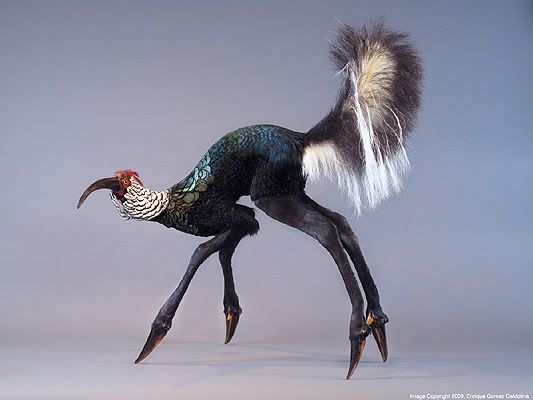
Rogue Taxidermy is a folk-art form where you use dead animal parts to create some new, unique creature that never could have existed... but should have! So appropriate for Halloween.

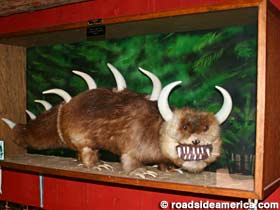
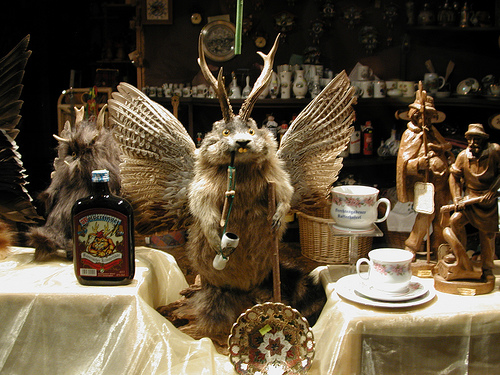
The folk art form of rogue taxidermy seems to be rooted in the midwestern United States, and can be considered a hallmark of Midwest Gothic. The most famous group is the Minnesota Association of Rogue Taxidermists. One typical truckstop chimera is the jackalope:
Rogue taxidermists got so carried away with the jackalope thing that they managed to infuse the critter into the North American culture at large, and now no roadside truckstop is complete without a mounted jackalope head on the wall. There's jackalope tattoos and faux nature documentaries and hundreds of photo manipulations. Jackalopes are world famous, a triumph of rogue taxidermy! Future popularity to a similar degree may be won for the hodag:
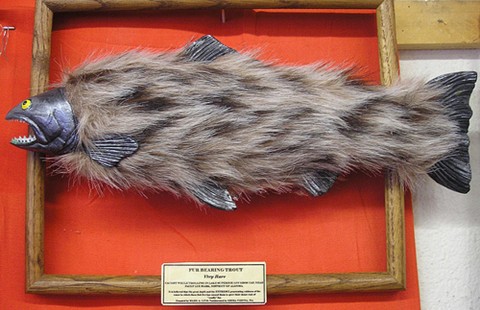
Or the fur-bearing trout:
As you can imagine, there's a huge crossover between the rogue taxidermy and cryptozoology worlds. Whether through intentional attempts to hoax the public, or tongue-in-cheek attempts to hoax the hoaxers by going "Look, I found one!"

Friday, April 26, 2013

How did hippos get to Columbia?

Well, as the video explains, the hippos - the original pair, anyway - were part of the menagerie of Pablo Escobar, famous Columbian drug lord. They adapted to the environment and roam free today, starting from a breeding pair.

The life and times of Pablo Escobar read like something straight out of Scarface. Legends of his tremendous cocaine-fueled wealth even include an anecdote of how they had to store cash in a warehouse for so long that rats broke in and gnawed 10% of the stored $100-bills, destroying them. Escobar's henchmen just shrugged and wrote it off as a loss.

Anyway, when you're so goddamned rich that you have a problem with rats eating your money because you can't spend it fast enough, you tend to splurge on a few indulgences. So Escobar built himself a wonderland, complete with his own zoo. What a show-off!

And that's why today, hippos are now a native species in Columbia.

Saturday, April 6, 2013

A hermit crab in a glass shell


"Hermit crabs are not really classed as crabs due to the fact that they do not own their own shell."

"The shape of the shell that a baby hermit crab chooses determines the shape of its abdomen."

 "Hermit crabs will often consume their old skin for its nutrients."

And more hermit crab facts...
 

Friday, February 15, 2013

The Great Moon Hoax of 1835

If you think modern media is rife with sloppy fact-and-source-checking and complete disregard for integrity, you should see what lulus they pulled back in the day.

In August of 1835, the New York Sun newspaper indulged in a particularly fanciful bit of tabloid reporting claiming that a new high-definition telescope was pulling in evidence of life on the moon - including unicorns, tailless beaver-like creatures, and batmen. Yes, real, flying, bat-winged batmen! Plus beaches, oceans, forests, temples constructed of sapphire, and all kinds of fanciful stuff.

While readers were presumably clued in that the whole thing was meant to be an amusing hoax, editors from competing newspapers were not so amused. As told on HistoryBuff.com:

"Rival editors were frantic; many of them pretended to have access to the original articles and began reprinting the Sun's series. It was not until the Journal of Commerce sought permission to publish the series in pamphlet form, however, that Richard Adams Locke, confessed authorship. Some authorities think that a French scientist, Nicollet, in this country at the time, wrote them."

"After a number of his competitors, humiliated because they had "lifted" the series and passed it off as their own, upbraided Day, the Sun of September 16, 1835, admitted the hoax. When the hoax was exposed people were generally amused. It did not seem to lessen interest in the Sun, which never lost its increased circulation."
Really makes you wonder if you repeated the exact same experiment today, how many would fall for it all over again. After all, according to a 2005 New York times story (if we can believe this one!), one in five adult Americans believe that the sun revolves around the Earth.

Friday, November 30, 2012

Science fiction film biology

 
A site at the University of Chicago speculates on the "what-if"s of sci-fi B movies, from King Kong to tiny shrinking people:
"When the Incredible Shrinking Man stops shrinking, he is about an inch tall, down by a factor of about 70 in linear dimensions. Thus, the surface area of his body, through which he loses heat, has decreased by a factor of 70 x 70 or about 5,000 times, but the mass of his body, which generates the heat, has decreased by 70 x 70 x 70 or 350,000 times. He's clearly going to have a hard time maintaining his body temperature (even though his clothes are now conveniently shrinking with him) unless his metabolic rate increases drastically.

Luckily, his lung area has only decreased by 5,000-fold, so he can get the relatively larger supply of oxygen he needs, but he's going to have to supply his body with much more fuel; like a shrew, he'll probably have to eat his own weight daily just to stay alive. He'll also have to give up sleeping and eat 24 hours a day or risk starving before he wakes up in the morning (unless he can learn the trick used by hummingbirds of lowering their body temperatures while they sleep).

Because of these relatively larger surface areas, he'll be losing water at a proportionally larger rate, so he'll have to drink a lot, too. We see him drink once in the movie--he dips his hand into a puddle and sips from his cupped palm. The image is unremarkable and natural, but unfortunately wrong for his dimensions: at his size surface tension becomes a force comparable to gravity. More likely, he'd immerse his hand in the pool and withdraw it coated with a drop of water the size of his head. When he put his lips to the drop, the surface tension would force the drop down his throat whether or not he chooses to swallow."


Wednesday, November 28, 2012

Karni Mata, the Hindu Rat Temple


There's a lot more videos on YouTube where that comes from. The temple of Karni Mata comes complete with silver gates, marble carvings, hundreds of hidey-holes, and that stylish checkered flooring (pity the poor sap that has to clean it!).

Supper time for the well-tended-to rats:


Hindus and animal-housing temples just seem to go together. There's also the Ubud Monkey Forest and temple in Bali, where they have so many temples it's all you can do to find a non-holy place to pee (unless they have a special pee temple too?).

Saturday, October 20, 2012

Google Street-View, monkeys in a hot spring


Via 9Eyes, a project that seeks out interesting images found on Google's StreetView images.

Friday, October 12, 2012

Have you met my friend Jenny?

Jenny Haniver, that is. These charming little devilish creatures are made from dead sea life such as rays and skates, taking advantage of their natural features. They're dried and then carved or shaped into natural poses to suggest demonic mermaid-like life. The 16th-century Swiss naturist Conrad Gessner was a known fan of the dolls.

Monday, June 11, 2012

Stuffed, Mounted Griffin, Anyone?


Sarina Brewer is a taxidermist who makes fantastic creatures from mythology, and this is her website.

Brewer is a devoted wildlife preservationist and naturist who also volunteers at the Science Museum of Minnesota. She follows a "waste-not, want-not" policy, so that none of the animals she works with were killed for the express purpose of taxidermy. Obviously, when you follow a policy like that, you end up with lots of spare parts, and well, this happens...


Friday, May 4, 2012

How various animals react to an earthquake

On August 22nd, 2011, a 5.8 earthquake hit Washington, DC, home to the Smithsonian National Zoo. While mostly non-destructive, it did rattle a few cages and nerves. This afforded a rare opportunity to observe the various animal's reaction to the quake.

  • About five to ten seconds before the quake, many of the apes abandoned their food and climbed to the top of the tree-like structure in the exhibit.
  • The red ruffed lemurs sounded an alarm call about 15 minutes before the quake and then again just after it occurred.
  • All the snakes began writhing during the quake.
  • The ducks immediately jumped into the pool.
  • The beavers stopped eating, stood on their hind legs and looked around, then got into the water.
  • The lions all stood still and faced the building, which rattled during the quake.
  • The flamingos rushed about and grouped themselves together, where they remained huddled during the quake.
  • The deer immediately ran out of the barns and appeared agitated during the quake.
  • The giant pandas showed no reaction whatsoever.

In addition, after the quake several animals began vocalizing in alarm and annoyance, notably an orangutan, the howler monkeys, and the female deer.

Here's a news story reported after the incident, with naturist Jeff Corwin:

Thursday, April 19, 2012

We're all descended from ancient Egyptians


A genealogy researcher has come to the startling conclusion that humans - all 7 billion+ of us - come from one big family tree, and furthermore that its roots are located in Egypt.

In "Common Ancestors of all Humans", Humphrys makes a strenuous case that we're all a lot more interrelated than we thought. It isn't even anything remarkable to say that we're all related - this has been claimed by anthropologists before. But this site goes the step further and concludes that the Ancient Egyptian Pharaoh Khufu, circa early 2500 B.C., is the great grand-daddy of us all.

One of the effects that goes into this is the phenomenon of pedigree collapse. This states that if you must insist that none of your ancestors were related, then you have a binary family tree that can only go back 30 generations before maxing out at a billion people - greater than the population of the world at the time! Thus, it is logical to conclude that in a world where the human population is always increasing, we would necessarily have had to have gotten those offspring from a smaller pool of ancestors.

This quote from the Wiki sums up the situation nicely:


"Small, isolated populations such as those of remote islands represent extreme examples of pedigree collapse, but the common historical tendency to marry those within walking distance, due to the relative immobility of the population before modern transport, meant that most marriage partners were at least distantly related. Even in America around the 19th century, the tendency of immigrants to marry among their ethnic, language or cultural group produced many cousin marriages."
If you're not already feeling a little queasy from the incestuous implications, consider that most religions have a creation myth involving an Adam and Eve figure, so they've been going around saying as much for years.

Sunday, March 18, 2012

Bad Assumptions We Always Make About Extraterrestrial First Contact


Whenever I see a guide to what to do in case of first alien visitor contact (like this one), I always see the same stupid assumption made: the alien flew here in a big shiny ship, so obviously it's a highly advanced species compared to our own.

Bunk!

Then there's a section instructing you on how to scurry around trying to communicate with the aliens to show off how smart you are. You know, to prove we're sentient, and hence "worth getting to know".

Right there, there's some bad assumptions:
  1.   Who says they wouldn't eat a smart species? Maybe they consider sentient species a rare delicacy.
  2.   Maybe they actually aren't seeking out other sentient species. We humans, social animals, assume that the prime motivation for intergalactic travel is to party with some friends. Maybe the aliens want to think of themselves as the only sentient species in the universe, and they're just here to strip-mine the planet and leave.
  3.   Maybe they're looking for slaves. If they're just out to snap a remote control onto your spine and make you do their bidding, extra IQ points just make you that much more useful.
  4.   Maybe they met something else, like bats or dolphins, before they met you. And since it might turn out that bats or dolphins are smarter in their own way than humans are and if the aliens just happen to jive more with the other critters than they do with us, maybe all your showing off is for nothing.
  5.   Maybe they rate intelligence on a different scale from us. Perhaps, like bees and termites, the aliens are born with instinct already in place so they intuitively grok math and engineering, but they judge intelligence based on how well you can juggle or how well you can sing in the 20-40 kHz range.
  6.   Who's to say we don't scare the daylights out of them? There might be something about us that's horribly disturbing to them, like how we smell or the fact that we have hair. They'd be unable to see us as anything but hideous monsters and no matter how much smarts we show off, they'd just be consumed with the thought that anything as repulsive as us must die.
  7.   You know how we humans have religions that make us expect crazy things to happen and react in bizarre ways? Now imagine aliens with some unfathomable dogma which dictates that Earth is Hell and everybody living on it is a demon. How do you P.R. your way out of that one?
We have to be lucky enough to have avoided all of those scenarios before we even have a chance of making a good first impression and having it do us any good. Now back to our first bad assumption: That the aliens, themselves, are advanced, or even sentient!

The first argument I usually find is "But they got here, so they obviously must be smart!"

Well, even an animal can float on water on a raft. Primitive tribe people rowed out to islands on boats. Maybe they got here by accident.

That's usually followed by "But they crossed interstellar space, so they must have invented faster-than-light travel!"

Please, if this was your first thought, sit down before you hurt yourself! Maybe the aliens have lifespans in the hundreds of millions of years, and so a trip of 17,000 years is just a relaxing nap to them. We humans have pathetically short lifespans, you know, even compared to many other species right here on Earth. It could turn out that we got stuck with the shortest lifespans of any sentient species in the universe, and so we are unable to conceptualize traveling to other stars without breaking the laws of physics in order to reach our destination before we die. Every other species can just launch a soapbox with a pile of TNT, pointed in the right direction, then patiently sit there waiting 17,000 years to reach their destination.

Or they could have a generation ship. Or they could just clone new bodies and use them for personal organ banks. Or maybe they've embraced technology to the point where they're cyborgs who effectively can just turn themselves off to save energy and have their extremely reliable electronics turn them on when they get here. Or maybe the big, shiny flying saucer is actually a scout ship built and launched from their space station out past Pluto.

See how humans have a hard time thinking outside of their tiny little frame of reference?

But beyond all of this, who says that we're talking to the smart alien race at all?

  1.   Maybe we're actually talking to a robot. If you went across space with the responsibility of contacting aliens who, for all you know, might be hostile, would you rather send a robot avatar to test the water first, or just boldly charge out the hatch and risk becoming the first human victim of the disintegration ray?
  2.   Maybe we're talking to an enslaved race, or the domestic pets of the race which built the spaceships. Same reasoning as the robots, and who says we're the first species the aliens have ever contacted? Maybe they've been setting up franchises all over the galaxy since before the tiny speck of dust we call home even formed?
  3.   Since when do the engineers who designed the ship also become the ones assigned to drive it around? If an alien encounters your average human driving a car, should they assume that said human understands the intricacies of an internal combustion engine? You drive, but you have to take your car to a mechanic to be repaired (excepting those of you who are mechanics themselves), do you not?
  4.   Think military: What invading army puts its head general at the front line? Maybe we're talking to the dumb grunts sent to scout us out for invasion and report back.
  5.   We might be dealing with a hivemind. Like bees and ants, no individual member of a hivemind will have any noticeable intelligence; it's only together with its 100,000 sisters that it starts looking sentient.
  6.   One more thing: Who says that anything built their ship at all? Maybe the ship itself is a life form, like a giant space turtle, or an asteroid covered in coral that steers it around. Maybe what we think of as the ship is actually the intelligent life form, and the beings we see riding on it are just parasites. We could go on all day here. It is impossible to think of every possibility - even our scientific exploration on Earth has rebuked us again and again with the stunning diversity of life and the unexpected ways it gets by!
I don't know what the rest of you have planned. Given all the unknowns, it may not matter at all what we do when that momentous first contact happens. The safest bet that I'm considering, should I be in the position of human race ambassador, is to turn the tables on them: make them prove their sentience to me first. I'll just start inspecting everything about them, and record and document everything I can. If they really are interested in meeting other smart species, they'll recognize this as a sign of my own sentience - maybe it will even be better to put them off-guard and feel a little intimidated, just in case they have hostile intentions.

But there is simply too much we humans assume about everything all the time to ever have the slightest idea what we should do when that moment comes.

Humans actually suck at trying to conceptualize in non-human ways. We have a hard enough time empathizing with our own next-door neighbor now.

Update: Over a year later, Why We'll Never Meet Aliens makes it to the front page of Slashdot. Note the backlash: I always see hate and ridicule from commenters when it's not starry-eyed utopia news. Apparently the Internet only reveres science if science is a big jolly guy handing out presents.

Monday, December 26, 2011

Before there were iPods, the Katzenclavier


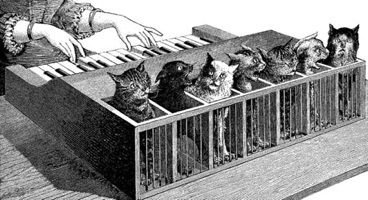
A cat organ is a musical instrument in which a series of cats are arranged in a row by vocal range, with their tails secured inside the machine with a keyboard attached, such that when a key is played the corresponding tail is pulled and makes the cat yell.


Referenced in this music ensemble posted recently on BBC news, where Prince Charles just thinks this is the funniest damn thing ever, even though they're only playing "Somewhere Over the Rainbow" using toy doll cats (animal rights people, you can relax now).

Meanwhile the Wiki page on cat organs describes some pretty disturbing abuses of animals for entertainment's sake in general.

Would you believe there's a whole field called "zoomusicology", dedicated to the use of fauna in composition? There is an elephant orchestra in Thailand, thankfully with the elephants playing instruments rather than being the instruments themselves. And then there's Hatebeak, a death metal band employing a screeching parrot for vocals (and they still sound better than Nickelback).