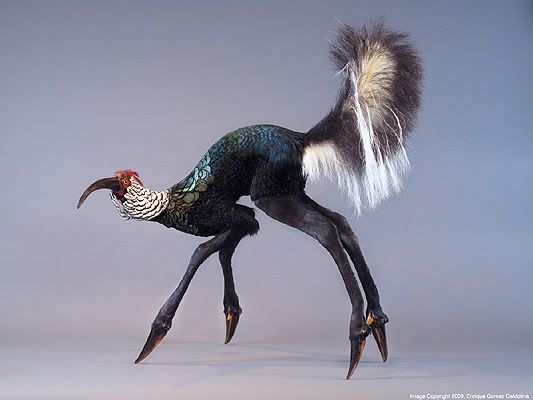
Rogue Taxidermy is a folk-art form where you use dead animal parts to create some new, unique creature that never could have existed... but should have! So appropriate for Halloween.
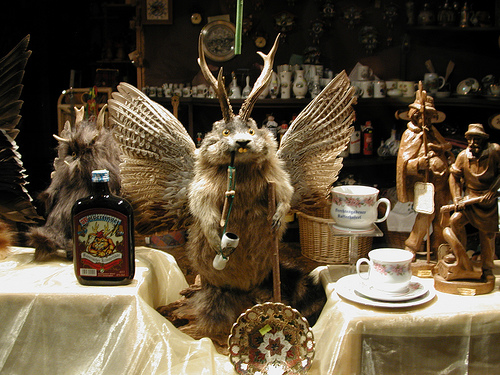
The folk art form of rogue taxidermy seems to be rooted in the midwestern United States, and can be considered a hallmark of Midwest Gothic. The most famous group is the Minnesota Association of Rogue Taxidermists. One typical truckstop chimera is the jackalope:
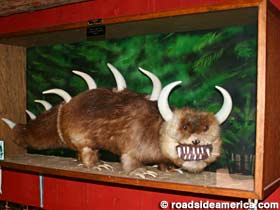
Rogue taxidermists got so carried away with the jackalope thing that they managed to infuse the critter into the North American culture at large, and now no roadside truckstop is complete without a mounted jackalope head on the wall. There's jackalope tattoos and faux nature documentaries and hundreds of photo manipulations. Jackalopes are world famous, a triumph of rogue taxidermy! Future popularity to a similar degree may be won for the hodag:
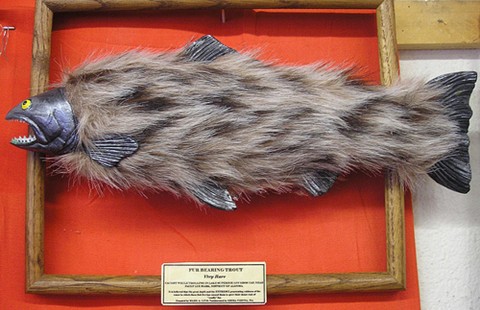
Or the fur-bearing trout:
As you can imagine, there's a huge crossover between the rogue taxidermy and cryptozoology worlds. Whether through intentional attempts to hoax the public, or tongue-in-cheek attempts to hoax the hoaxers by going "Look, I found one!"
I know this isn't the first time this has been done, but the town of Rjukan, Norway, is installing mirrors on top of local mountains to reflect light into the town square during the sunless winter months of the far north. I always love stories like this, because they show off the clever audacity of the crafty ape we call man. A related concept is that of daylighting, where architectural measures are taken to treat buildings with natural sunlight where possible. And I mentioned this has been done before; specifically, in Viganella, Italy, mirrors were constructed on local mountaintops to reflect sunlight into the city's valley, which, due to the depth of the valley, was resigned to shadows for so long in the year. Here's the trailer for the documentary about Viganella's mirror:
Oh, and the town of Rattenberg, Austria, also did the same thing, for the same reason as Rjukan.
Roy Sullivan got into the Guinness Book of World Records as having been struck by lightning seven times - and survived them all! This was seven separate incidents, mind you, over a period of years from 1942 to 1977. He also claimed an eighth strike which happened to him as a child, but never bothered to record it. Perhaps bothered too much by the way God seemed to have it in for him, he committed suicide by gunshot at age 71. His experience, however, form an important contribution to the specialized medical field of Keraunopathy - the study of the effects of lightning strikes on the human body.
"The Madre Tierra Eco-Resort is located a mile from the center of Vilcabamba, the Andean village made famous for the longevity of its citizens. Visitors come from all over the world for the relaxed atmosphere, the deliciously healthy food from our gardens, the mineralized pure water, the fresh, clean air and to spend time among Ecuador's very gentle people."
And this creation, sleeping mother earth personified.
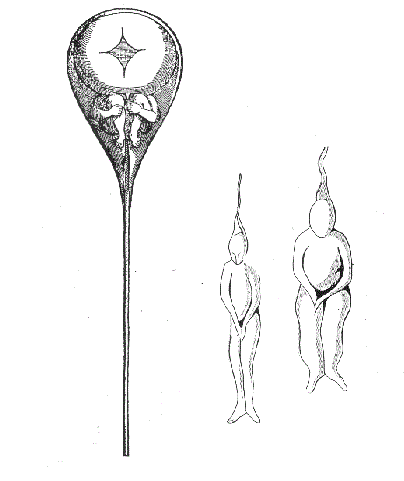
TIL folks of a few centuries ago believed that sperm cells contained little tiny people, perfect replicas of the humans they would become. As told here. In the modern day, we've moved on past the silly idea of perfect replicas embedded in sperm or egg cells; now the anti-choice religious crowd insists that conception makes a perfect little tiny person.
Well, as the video explains, the hippos - the original pair, anyway - were part of the menagerie of Pablo Escobar, famous Columbian drug lord. They adapted to the environment and roam free today, starting from a breeding pair. The life and times of Pablo Escobar read like something straight out of Scarface. Legends of his tremendous cocaine-fueled wealth even include an anecdote of how they had to store cash in a warehouse for so long that rats broke in and gnawed 10% of the stored $100-bills, destroying them. Escobar's henchmen just shrugged and wrote it off as a loss. Anyway, when you're so goddamned rich that you have a problem with rats eating your money because you can't spend it fast enough, you tend to splurge on a few indulgences. So Escobar built himself a wonderland, complete with his own zoo. What a show-off! And that's why today, hippos are now a native species in Columbia.
The answer turns out to not only be fascinating, but a nice little cottage industry. Ecosphere is a company that sells just such an item: a glass globe with simple plant and animal life forms, which you just set in the window and let sunlight do the rest. It's basically a sealed, maintenance-free aquarium. Here's a video of one in action:
From the site:
"Because the living organisms within the EcoSphere utilize their
resources without overpopulating or contaminating their environment, the
EcoSphere requires virtually no maintenance. EcoSpheres have an average life expectancy of two years. However, it
is not uncommon for shrimp populations to be thriving in systems as old
as 7 years."
One wonders what the long-term implications of this would be. What if generations reproduced within the ecosphere - would they mutate? Could they evolve? Certainly, sealed systems in nature do tend to produce life forms with exaggerated characteristics. Could the system survive a global apocalypse? It needs sunlight energy, so we know it couldn't survive in space, but what if we included an artificial life source and launched it at habitable planets? Would the seed be planted for Earth-like, but adapted, life forms when we eventually go there?
"Hermit crabs are not really classed as crabs due to the fact that they do not own their own shell." "The shape of the shell that a baby hermit crab chooses determines the shape of its abdomen." "Hermit crabs will often consume their old skin for its nutrients." And more hermit crab facts...
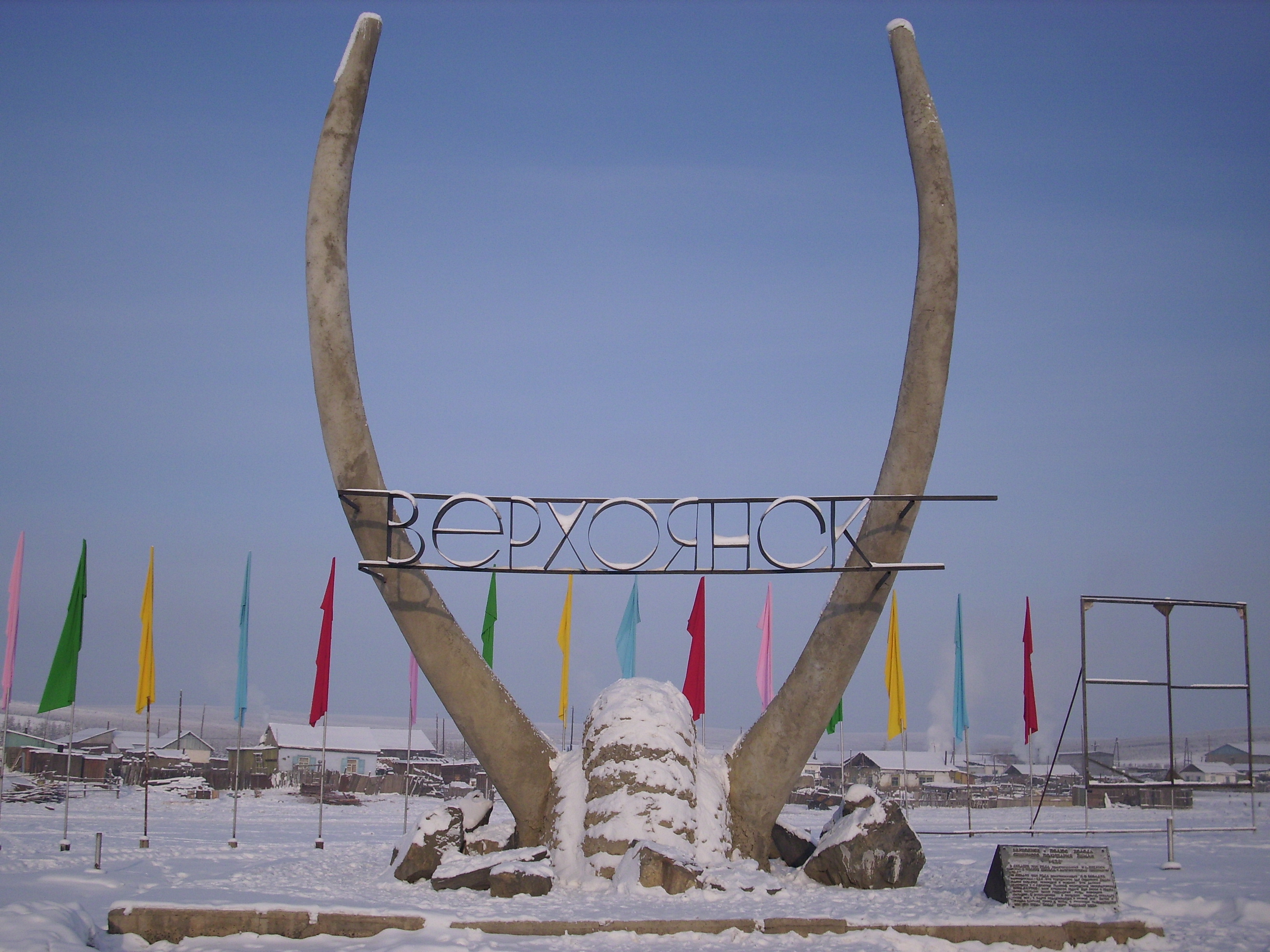
Verkhoyansk, in the Sakha Republic of Russia, is within the Arctic circle and considered close to the coldest pace on planet Earth, being one of the "cold poles", with temps running below freezing October through April and as low as -49-degree F in January.
Here's the town, competing with the other "cold pole" ( Oymyakon ) for title of "coldest place on Earth. The lowest temperature in Oymyakon recorded was -67.7 degrees, but Verkhoyansk citizens say that's nothing, their lowest temperature was -67.8 degrees. I'll bet the citizens of Verkhoyansk like to poke fun at Oymyakon by going over there and unzipping their parkas going "It's so hot here, how can you stand it?"
Just in case you were thinking that the New Age hippies had backed off from the dolphins, this LiveJournal observer has bad news:
"I hadn’t realized that among a certain segment of profitable 'eco'-tourism it is a commonly-held belief that dolphins not only have achieved higher consciousness and are intimate with the secrets of life, but also use telepathy to transmit their teachings.
"My favorite interaction with a dolphin-oriented wingnut occurred at the dump. As we threw our trash in the big stinky dumpster, a woman pulled up in her SUV plastered with hippie/new age bumper stickers. Dressed in all white, she asked us, 'Have you seen the dolphins?'
"'Not today,' I answered.
"'They’re out there right now. Did you know that humans are the only animal that fears when it doesn’t need to? Dolphins only fear when they are in danger?'"
Penn 'n' Teller's Bullshit did a whole episode on dolphin New-Age-ism, BTW:
At least, according to NASA's study of the sound that black holes make. The B-flat is well below the human range of hearing, at 57 octaves below middle-C. The sound's frequency is a million billion times deeper than anything any human has ever heard.
For this festive holiday season which we just kicked off today, we celebrate a time when radioactive Christmas trees were an actual headline - another side effect of the 1986 Chernobyl disaster in Ukraine. This story from 2002...
"Officials seized the fir trees at local markets in the southern town of Rovno, where they were being sold for the upcoming Orthodox Christmas, Itar-Tass agency reported.
"The nuclear disaster at Chernobyl was the world's worst
After the region was covered by a radioactive cloud, a complete ban on the felling of trees in the contaminated forests surrounding Chernobyl was imposed.
"Police said the local businessmen knew the trees from the Zhytomyr region were contaminated, and used forged documents to sell them. "
The fallout from Chernobyl was felt in many ways that were unexpected. The incident and area today provide an outstanding living experiment in just what happens to the environment after a nuclear meltdown. But along with this has come a tragic toll of death and weird tragedy - (warning, that page contains an image of a mutated puppy).
The Echizen jellyfish, AKA Nomura's jellyfish, can reach a diameter as long as a human's height. It's native to the coasts of Japan and China, but has been thriving lately due to overfishing in the area removing its competition. And this diver's ballsy getting close enough to it to tag it with a sensor!
The Pemba is a species of megabat native to Tanzania (east side of lower Africa, for the geographically slow). At a six-foot wingspan, they're one of the largest bats and the perfect critter to kick off the month of Halloween.
The Fiji Mermaid, often ranked today as one of the top ten science hoaxes, was a hoax exhibited by P.T. Barnum at sideshows. It was later revealed to be a top half of a monkey sewn onto the bottom half of a fish, and rather artlessly at that.
However, one need not think that early beliefs in mermaids were entirely founded by superstition; there is a rare congenital birth deformity known as Sirenomelia, in which a baby is born with the legs fused together.
A post about it here, but be warned, some photos are shocking. And Googling the name in images isn't advised for the nervous, either.
Theo Jansen is a kinetic sculptor in the Netherlands who creates his own skeletal walking beasts, and this is one of his contraptions:
Jansen frequently turns his mechanical beasts loose on beaches and other wide, flat areas. One can only imagine the thoughts of the unprepared beach-goer who flips over from their restful tanning only to find one of these behemoths bearing down on them.
Jansen's own site features a video on the front page which is even greater in its grace and beauty. These kinetic sculptures, made from PVC pipe, wood, and recycled plastic bottles, are able to power themselves by wind. Not only can they walk, but some models can even sense when they're staggering into water and steer away, while others anchor themselves down if they detect a storm approaching.
Jansen intends to develop prototypes until he has models robust enough to turn loose on the beaches of the world to live out their own lives. If he does, these engineered organisms could well prove to be a phenomenon for generations to come. Perhaps, even after life on Earth is no longer feasible for other life forms and humans have long abandoned the Earth to its fate, there will still be the Strandbeasts, busily striding about on the sand, the last inheritors of the Earth.
"Biobots" "roboroach", and "cyborg roaches" are just a few of the names being given to the emerging technology of driving a remote-controlled cockroach for useful purposes... such as searching for earthquake survivors. As the linked article reasons, why go to the trouble of building a robot to crawl through rubble when nature has already given us a perfect design that's more than up to the task? Roaches can squeeze through tight spaces and seamlessly traverse walls, edges, ceilings, and just about any shape, right side up or upside down! Even our best designs are still years from accomplishing this.
There's a video at that link. Here's a few more examples of this bizarre field of research (trigger warning for anybody with entomophobia):
As this video shows, you could easily make this a flying unit with a little helicopter rigging:
You could also help them on their way by giving them their own ground vehicle to pilot:
And before everyone starts yelling about "cruelty to animals": (1) They're bugs. They process pain/discomfort differently than we do (and how do we know they aren't having a blast anyway?) (2) From exterminators to flyswatters to electronic bug-zappers, we've been killing bugs off en mass practically since we first found one, and nobody's protested yet. Don't pick a time when we're doing important things in science with them to get high-and-mighty now.
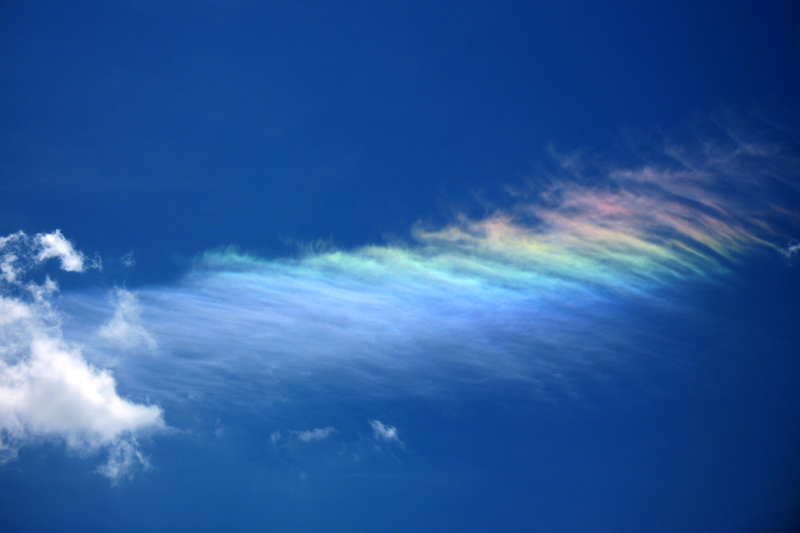
The concept is called a "circumhorizontal arc". It's an atmospheric phenomenon in which sunlight strikes airborne ice crystals to produce a rainbow effect. Four things have to happen for this to be seen:
The sun has to be higher than 58 degrees above the horizon.
There has to be a mild haze, such as cirrus clouds, slightly overcast, a marine layer, etc.
The clouds must contain flat, hexagonal ice crystals.
You have to be standing farther than 55 degrees latitude away from either pole.
For these reasons, the rarity of the event causes it to only be visible from certain parts of the world at certain times of the year. In North America, it's most commonly observed inland and to the north during the colder months, although as long as there's ice in the clouds and you're standing in the right spot, it could happen anywhere.
Because of the rarity of the event and the strange cloud formations that sometimes occur in conjunction with it, the phenomenon could be mistaken for things like UFOs and other conspiracy-laden legends.