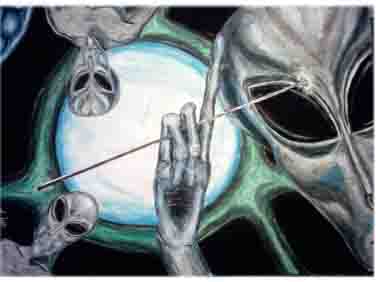
"Clear facts indicating that you have been abducted by aliens:
You can hear voices in your head. This can probably be the sign indicating that you were abducted by aliens, but before claiming that fact make sure you don't have earphones on."
Interestingly, in the Wikipedia section on notable alien abduction claims, six of the eleven listed are from the USA. This means that either Americans are more interesting to aliens than anybody else, Americans are more prone to make a claim, or other countries are underreporting.
And don't forget to mark it on your calendars: March 20th is Alien Abduction Day. Along with making sure your bags are packed and your shots are current, that link will point you to many more helpful resources including hot spots for UFO watching and alien abduction safety (like, in case you want to refuse going, for some crazy unfathomable reason). The PDF pamphlet on "How To Refuse Alien Abduction" is solid gold, not to be missed.
Speaking as a former Southern California mall rat, one of my favorite experiences from childhood was riding the "Adventure Through Inner Space" ride at Disneyland. They shut it down in the mid-80s to replace it with Star Tours - albeit, also a great attraction. But not the same. And it marked the point of cultural sea change in the United States between its peak and its decline. Here is the Yesterland page mourning its passing.
ATIS was a science fiction ride. In it, we use the excitement of cutting-edge (for the time) science to instill a sense of wonder, through the fantasy element of entering a magic microscope which makes you smaller. The cheery 1950s' song "Miracles From Molecules" greets you as you exit the ride - literally, the message is that the road to future Utopia was paved with scientific progress.
Star Tours is just about the Star Wars franchise and - there will be no way to avoid angering fans so I'll just say it - Star Wars is NOT science fiction. Star Wars is space opera, a Western cowboys-and-indians shoot-em-up set in space. Gone is the enthusiasm for science and the inspiration to look to a better tomorrow; instead the story, set "a long long time ago" is a Gothic post-modern fairy tale. What a poignant indicator to mark the shift in US culture! We gave up on getting into space ourselves - here, here's a fairy tale about how space politics would be just as messed up as US politics anyway. Enjoy your sour grapes.
ATIS sounds incredibly lame to modern kids, sounding more like a hyperthyroid science fair project than a ride, and that just goes to show how our modern culture has broken the present and new generations. To a six-year-old, years before the era of CGI effects, ATIS was scary. As you waited in line, they make it look like shrunken passengers were proceeding to the end of the microscope phasing into nothing. It was a stunningly realistic effect. The cars look like they go right up there. Near the end, a huge human eye peers down on you. The ride is mostly in darkness, with bright flashing lights all around you simulating thrilling interactions on the atomic level.
But all of this would be pretty pedestrian without the hypnotic voice of Paul Frees. As the narrating scientist, he commands your attention and shapes your thoughts with lines like "I am the first person to make this fabulous journey!" and "What compelling force draws me into this mysterious darkness--can this be the threshold of inner space?" and "No, I dare not go on. I must return to the realm of the molecule, before I go on shrinking...forever!" Frees could sit down to the breakfast table and describe his bowl of cereal and make it sound too epic for mere mortal minds to face.
Sadly, no actual video footage of this iconic and original ride exists, since it was shut down before the age of cheap video recorder cameras. But one fan, name of Steve Wesson, has devoted eight years to recreating it in 3D computer-modeling animation, and it is very close to my memories of the ride:
The architecture around the ride itself was a feast of googie nostalgia. Read that carefully, that's "googie" not "Google". "Googie" is the style of retro-futurist pop-art style, common around the general Disneyland area of Southern California. Check the definitive page on the Googie style here.
Can there be any more compelling argument that the United States gave up its dreams than that rides like ATIS and styles like googie now seem quaintly outdated? We used to look forward to the future - it was filled with exciting things and it made all the kids want to be scientists so we could get there as soon as possible and have out flying cars and robot maids. But our attitude towards the future changed from optimism to pessimism right about in the mid-80s. Cyberpunk came along, and with it came the cynical attitude that now said, "It wouldn't matter how much technology we invent; humans would be the same degenerate garbage anyway."
I cried when I saw that story. Those zombies are no joke to me. The zombies want us to be governed by books that are thousands of years old. The zombies hate science and learning and love backwardness and repression. The zombies can't deal with sex or education or a president of a different race. The zombies will be here soon to snatch this computer out of my hands and take away my car, forcing us all back to the iron age to trod barefoot through the mud building pyramids while zombies crack a whip over our backs. The zombies are in power. The zombies own America, and the few remaining humans are scrambling to throw off their oppression or escape to a free land.
The United States has become a nation of zombies, dead things shambling forth to steal away the space-age, atomic-powered future promised to me in my childhood by Paul Frees and his Adventure Through Inner Space.
This under-three-minutes excursion into sparkly-eyed madness got awards at a 2011 film festival. Twilight Zone episodes (the new ones) don't have this much bite.
Marika Rokk was a dancer and singer of German film. Unfortunately, she was at the height of her popularity right during the Nazi era, so she became indelibly linked with it. Nevertheless, as seen by the campy, original style of this production, she's worth a second look.
This film from 1958, titled "Mir Ist So Langweilig" (It means "I am so bored") shows a moon-woman spying an African tribe on Earth and blasting down to be frolic with them for the sheer novelty of it. Despite the racist overtone (she even draws her finger across the chest of one dark man to see if it would rub off, but is promptly laughed at for this), it's full of charming touches like the swaying astronauts and a cute rocket with a gyroscopic cockpit.
This was done after her pardon from her post-WWII professional ban. For a while there, they didn't let her perform because she was so associated with the Nazis, which, let's face it, is hardly her fault since she couldn't help who buys a ticket to her shows.
In Darren Aronofsky's 1998 film Pi, there's a scene where Max tells the Kabbalah that he's sure that they've completed their search for a number that is 216 digits long. He tells them,
"It's just a number. I'm sure you've written down every two hundred sixteen digit number. You've translated all of them. You've intoned them all. Haven't you? But what's it gotten you? The number is nothing!"
The problem is, this is impossible. There's 9.9*(10^215) 216-digit numbers. For comparison, recorded human history IN SECONDS is only 60x60x24x6000, about 1.8*(10^11). One billion computers, spitting out one number every second night and day since the dawn of human history, would not have generated every possible 216-digit number by now.
One hardly knows what to make of The Museum Of Bad Art. Some pieces, sure enough, are terrible, but then others at least show some technical proficiency. At least this is more than I could muster by hand.
But other works are defying of any explanation. What was the artist thinking, for instance, when they painted this? What cocktail of childhood traumas could possibly make someone draw such a creepy mother-child nightmare?
In 1948, producer Ken Murray was sitting around with a lot of time on his hands and thought "Hey, I'll just make an entire film about birds! Not a nature documentary, no, I mean birds as actors, telling a story, putting on a SHOW!" And this was the result.
Admittedly, this is the corniest idea you've ever seen go into a feature film, and they don't spare one kernel while they're at it - gag signs, lame puns, and endless gawking at the cute widdle birdies ensue. For being birds, they're pretty clever and do little tricks while the typicalmid-20th-century narrator yammers on and on about what the birds are doing since the birds don't actually talk - they really missed out not getting Alex the grey parrot - alas, it was before his time.
Just, y'know, don't expect A-list acting. It's just enough to sit through this thing in jaw-dropping astonishment that it got made.
Japan has an interesting and unique problem: Their population is bombing drastically. As of recent numbers, 21% of Japanese citizens are over the age of 65, and their birth rate just dipped below their death rate in recent years, meaning negative population growth.
While such things as overzealous family planning and factors which discourage large families have traditionally been to blame, this Escapist story makes the bold claim that the problem is, to put it bluntly, too many young males spending their time with anime and manga - in other words, too much gratification from cartoon porn instead of finding their gratification from actual flesh-and-blood women. (Yes, we know, there is more to manga and anime than porn - but come on, it isn't Mobile Suit Gundam or Deathnote that these guys would be using in place of a girlfriend.)
Still, if this is the real cause of the problem, one wonders what on Earth the females are doing. Are they just passively sitting at home watching the phone not ring? It takes two to tangle, you know.
This is also a possible omen for the rest of the human race. Japan is a first-world country. Are other first-world countries in danger of having their populations become so socially stunted that they can't manage to meet, mingle, and breed as well? Is there, in fact, a possible reverse-Malthusian disaster in our future?
An ancient monastery has stood in the low mountains of Alsace, France, for 1,200 years. It is celebrated for its beauty and is a must-visit stop on every scenic tour. It is encircled by a wall, known as the "Pagan Wall", composed of 300,000 blocks up to three meters tall, itself dating back to the 7th century AD. It was also the site of the crash of Air Inter Flight 148 in 1992, which killed 87.
But its history also contains an intriguing episode of daring-do. For, just after the turn of the century, books began to disappear from the Mont Sainte-Odile library. Over a two-year period, over one thousand books vanished, many of them priceless relics dating back to the 15th century, some with wooden covers and weighing several kilograms.
Now, this was no small theft. The monastery is secluded, perched atop rocky peaks, surrounded by a wall, and furthermore is inhabited by the priests. Yet over the years, as a new book disappeared every day or so, they could not find the elusive thief. Locks were changed, steel doors were reinforced, and yet the thefts continued, the phantom thief never leaving a trace except for one single rose he left one night just to taunt them. It wasn't until the historic monastery turned to modern technology that the thief was finally caught.
In June of 2003, a hidden video camera tripped up one Stanislas Gosse, aged 33, from the nearby town, who had been squirreling the books away in his home attic. He had discovered a secret route into the monastery from studying old maps at a public archive. A cupboard in the library let into a secret chamber, and a narrow stairway leading to access via climbing the wall.
His motive?
"It may appear selfish, but I felt the books had been abandoned. They were covered with dust and pigeon droppings and I felt no one consulted them any more."
Thomas Edison started it, as a suggestion for a greeting to say over the first telephones. His logic was that it could be clearly understood.
Alexander Graham Bell preferred "ahoy", like greeting a ship at sea, but the nautical reference didn't stick. The English had been using "hullo" as a standard greeting, whose entomology derives from Old High German expressions "hallo" and "hollo" and such. "Hollo" shows up as far back as Coleridge's <em>The Rime of the Ancient Mariner</em>, from 1798.
"Once the telephone was perfected, people had to learn to use it. There was a very fundamental question to be answered, one that seems quite odd to us today, and that is: What do you say when you answer a ringing telephone?"
"It was kind of a riddle in a way, because when you hook up a telephone and you are speaking basically to a stranger, it ran counter to what people expected in their day-to-day meetings, which was their previous experience. And you have to be properly introduced. And you're never introduced on the telephone that way. So you have to find a word or a phrase that very quickly cuts to the chase and allows people to start speaking, and 'hello' was pressed into service."
We could have just as easily ended up with "namaste" (pronounced "NAH-mess-tay"), since much of English is derived from Sanskirt.
Neal Stephenson blasts our minds with a much-needed reality check about the death of science progress in America.
Stephenson is shy about providing examples, but I'd be more than happy to show what kinds of progress we could be making:
Energy independence - Even without worrying about nuclear power or other "scary" concepts, plain old dumb wind and solar power could easily power the whole country. Why aren't we building windmills at the same rate we built oil-wells all across America?
Transportation - I just recently posted about "smart road surfaces", which could power electric cars, store data such as directions, and even possibly steer the vehicles themselves. Why aren't we laying these suckers all over the country at the same rate we laid transcontinental railroads?
Medicine - Stem cell and genetic technology has regenerated organs, reversed aging symptoms, and helped treat degenerate diseases. Why aren't we pushing forward with this technology at the same rate that we eliminated polio?
For that matter, even computers could be put to better uses. Why do we still have colleges and universities, when we could do all of our teaching online? MIT has led the way with online university courses, but there they sit unused. Why haven't elections gone on the Internet? We can conduct banking transactions online, but we still have to fill in bubbles on a paper ballot and mail it in? Why aren't telemetrics automating more tasks in life, like lawnmowers and street sweepers?
There's nothing to stop us from doing these things. The technology is simply there, all ready to go. We could do research until we're blue in the face, but America does nothing with the research we already have. And don't tell me "well, there's a budget crisis." There's always a budget crisis.That never stopped us before.
A solar roadway is a "smart road" which combines energy generation and driving surface. This is an idea us science fiction enthusiasts have been burbling about for years. Not only could enhanced road surfaces provide electricity for electric vehicles, but they could also have LEDs embedded into them for transmitting messages such as road conditions.
In addition, (now this is purely my own speculation), if the road can transmit a data signal, then why couldn't it also direct a vehicle? Imagine being able to hop into your car and say "take me to the Post Office" and the GPS works together with the road to drive you there automatically, removing the need for a human pilot at all. No more accidents from sleepy or intoxicated drivers! Road accidents kill over 40 thousand Americans per year. It would be a giant leap from solar roadways as we are presently seeing launched to autopilot roadways, but it would be a leap worth taking.
When most people talk about "caveman paintings", it's sites like Tassili n'Ajjer they have in mind. Human civilization in the area dates back to the Neolithic era (about 11,000 to 3,000 years ago) when earliest humans showed the first traceable signs of agriculture. The paintings depict herding, farming, and battles, showing the early use of crude tools and weapons.
It's also the site of a lot of controversial theories from the New Age crowd. While the images are doubtless very crude and the product of people unstudied in representational art (because they freaking invented it on the spot), some people point to different-shaped figures as evidence that there were once giants, aliens, and other fantastic creatures.
Those interested in this view can check out this write-up asking "ETs stalking primitive tribesmen?". This is also the same site (and the same paintings) that inspired Terence McKenna (author of Food of the Gods series) and other authors to speculate that ancient peoples ate psychedelic mushrooms and talked to space aliens - not necessarily in that order.
The big story here is that there was once a grassy savanna where the Sahara desert now lies, and that there was a sudden leap in human progress ten thousand years ago when humans transitioned from hunter-gatherers to herder-farmers that gave them such luxurious living that they could afford the time to loll around drawing pictures on the rock. And, by the way, could incidentally have such a sense of community that they could choose sides in a war.
Jason Scott, of textfiles fame, has scanned in some vintage pulp comics for preservation at the Internet Archive. The Ace Comics Collection so far includes Ernie, Baffling Mysteries, Atomic War, Andy, Western Adventures, and many more. These are from the somewhat rusty pre-golden age of pulp comics between the 1930s and '50s.
Ace Comics were a notorious pulp publisher, not to be confused with David McCay Publishing's Ace Comics title. Ace Comics published horror / detective series for the boys and love story / soft porn for the girls, and never mind justifying the art. In fact, they were an early scapegoat for the moral panic over comics that lead to the Comics Code Authority.
In the Western world, we know today as Groundhog Day. However, this is yet another mistranslated holiday on the American calendar. It's actually known as the "Presentation of Jesus at the Temple", the day when Mary was supposed to have taken Jesus into the temple 40 days after childbirth (in accordance with Abrahamic law) to participate in the purification ritual.
The event is also called "Candlemas" (because candles are blessed on that day, in references to the Gospel of Luke which calls Jesus "the light of the world"). It also answers to "Feast of the Purification of the Virgin" and several other names.
Wait, what does this have to do with groundhogs and weather? Like the crucifixion and bunnies and eggs of Easter, the answer lies once again in Pagan tradition. In the UK and Scotland, February 2nd is supposed to be the day that bears and wolves come out of hibernation and scout around to see if winter's over yet. Woven in with Pagan tradition, ancient holidays dating back to the Romans have early February as a time to watch the behavior of animals for omens and signs of the nature of the coming year.