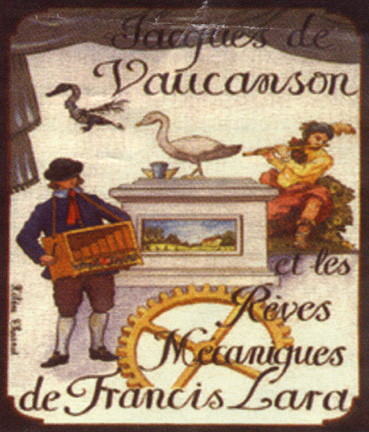
...it might only be a mechanical "digesting" duck.
Such was one of the iconic inventions of the dawn of the mechanical age, "The Duck." The steampunk creature of clockwork limbs could not only move, but simulate eating food and - sparing no effort in attention to detail - pass droppings as well, although the actual product was pre-stored and didn't involve actual biological digestion.
Such was the invention of Jacques de Vaucanson, widely considered to be one of the fathers of robotics or at least automata. He created this duck in 1738, for demos to the elite, using it to finance further creations.
Before you scoff too loudly at such frivolity, keep in mind that Vaucanson's major accomplishments included automated, programmable looms, which could be programmed with punch cards - in 1745. Later this same media storage format would be used to input data into the world's first computers.
You can still generate a punched-card design at emulators like this. I would recommend the 'bcd' command from the bsdgames package on Unix systems, but that's such lost technology that it's barely worth mentioning.
Showing posts with label Renaissance. Show all posts
Monday, July 22, 2013
Wednesday, June 26, 2013
Wacky medieval laws
During the height of witch-hunting in the 15th century, there was a book published in Germany that was a sort of "Witch-Hunting for Dummies" guide, name of Malleus Maleficarum.
Full page scans available at Cornell's online repository, and while you're there, they have a few other witch-related tomes to check out for all your witchery needs. There's also a full site devoted to this and other witch-related beliefs, even into the present day.
But even practices for catching plain old criminals wasn't much better. For instance, there was the process of cruentation, in which an accused murderer was brought together with the corpse of the presumed victim and ordered to lay their hands upon the carcass. If the dead body should then spontaneously begin bleeding from its wounds, that would be a sign from on high that the defendant was guilty. One can only imagine how many murderers got off scott-free.
Many such practices are covered in the blanket category of "Trial by Ordeal," where you get all the variations on tying you up and throwing you into the river to see if you sink or swim, or plunging your hand into boiling water to see if God healed you, or simply swallowing poison, or other such life-jeopardizing trials. In some cases, surviving the ordeal unscathed meant that God had declared you innocent, while in other areas it was considered just the opposite proof, that you had escaped by the Devil's aide.
Then there was the practice of compurgation, a law which meant that you could be found innocent if you could find twelve people who said they believed your side of the story. Well, who couldn't scare up twelve friends?
One more curiosity is the German principle of "stadtluft macht frei," a kind of statue-of-limitations where if a serf had managed to escape capture for a year-and-a-day, they was no longer open to being re-chained.
And for a final medieval law oddity, animals could be tried in a court of law exactly as if they were human.
Full page scans available at Cornell's online repository, and while you're there, they have a few other witch-related tomes to check out for all your witchery needs. There's also a full site devoted to this and other witch-related beliefs, even into the present day.
But even practices for catching plain old criminals wasn't much better. For instance, there was the process of cruentation, in which an accused murderer was brought together with the corpse of the presumed victim and ordered to lay their hands upon the carcass. If the dead body should then spontaneously begin bleeding from its wounds, that would be a sign from on high that the defendant was guilty. One can only imagine how many murderers got off scott-free.
Many such practices are covered in the blanket category of "Trial by Ordeal," where you get all the variations on tying you up and throwing you into the river to see if you sink or swim, or plunging your hand into boiling water to see if God healed you, or simply swallowing poison, or other such life-jeopardizing trials. In some cases, surviving the ordeal unscathed meant that God had declared you innocent, while in other areas it was considered just the opposite proof, that you had escaped by the Devil's aide.
Then there was the practice of compurgation, a law which meant that you could be found innocent if you could find twelve people who said they believed your side of the story. Well, who couldn't scare up twelve friends?
One more curiosity is the German principle of "stadtluft macht frei," a kind of statue-of-limitations where if a serf had managed to escape capture for a year-and-a-day, they was no longer open to being re-chained.
And for a final medieval law oddity, animals could be tried in a court of law exactly as if they were human.
Thursday, August 9, 2012
The Bizarre Images of the temple of Seti I, Abydos
Seti I was a pharaoh in the 19th dynasty of Egypt, the son of Ramesses I and father of Ramesses II. His temple is located in what is known today as the sacred city of Abydos, Egypt, which is considered one of the most important archaeological sites in Egypt. The walls are decorated with a host of inscrutable hieroglyphics, including a catalog list of the cartouches (symbols or seals) of every Egyptian pharaoh before him.
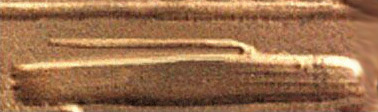
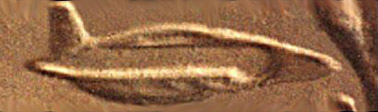
What grabs the attention of modern onlookers, however, is the uncanny resemblance between some of the symbols on the walls and modern inventions, including helicopters, submarines, and zeppelins:
This oddity has fed rumors of ancient aliens or time-travelers on the usual sites. However, there are perfectly mundane explanations for these figures, in that they aren't really detailed to begin with, have decayed several centuries, and could be depicting perfectly ordinary everyday objects of the time, or perhaps, like the sketchbooks of Leonardo da Vinci, been a particularly bright attempt at imaging the future. After all, our modern flying machines do indeed resemble natural flying creatures, and if any preindustrial artist would have been asked to imagine a man-built flying machine in the future, very few could argue against designing something that looks fairly like what devices we have today. You wouldn't imagine that an airplane shaped like a fish or turtle could fly, could you?
The complete diagram of the temple:
Abydos became a popular necropolis in ancient Egypt, containing many temples and burial sites devoted to Egyptian royalty. This has also led to the general area becoming a focus for all sorts of cult and superstitious activity throughout the decades. More research into this intriguing historical area here.
Labels:
architecture,
art,
culture,
flying saucers,
history,
mythology,
New Age,
oddities,
paranormal,
Renaissance,
science,
stone age,
time,
unsolved,
video,
weird
Friday, April 20, 2012
Having a monstrous time in Bomarzo
Scenes of nightmarish chaos form the attractions at this park in Lazio, Italy. The place is known as "The Park of the Monsters", and though you might think that fascination with monsters - to the extent of building monuments to them - is a recent idea, this park dates to the 16th century.
Sculptures include Cerberus, Pegasus, Proteus, plus many other figures of mythology, random bears, dragons, and other large brutes, and one particularly grotesque face whose gaping mouth forms a gate. Also, one house purposefully built to lean several degrees to the side, in case you thought the Tower of Pisa was the only tilted building in Italy.
Labels:
architecture,
art,
creepy,
culture,
history,
mythology,
oddities,
Renaissance,
street art,
weird
Monday, March 26, 2012
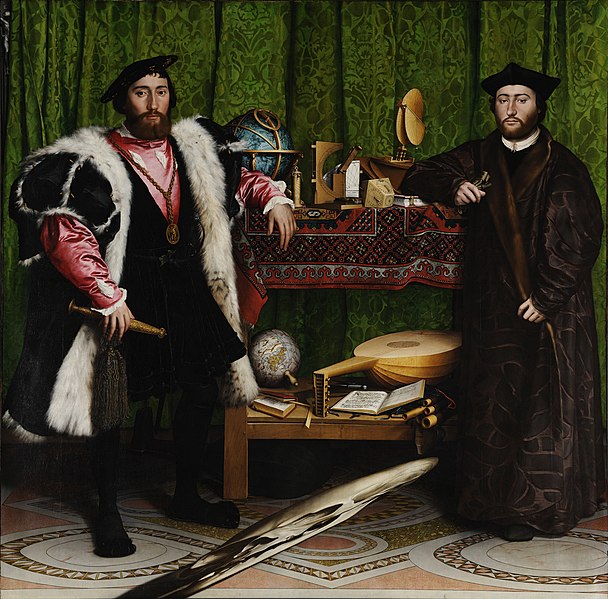
The Visual Puzzle in Hans Holbein the Younger's "The Ambassadors"
You've probably seen this painting making the rounds on optical illusion websites:
It's become popular lately thanks to Google Art Project, the first attempt at putting high quality scans of paintings online for access. The curiosity value, of course, comes from the distorted view of the object in the extreme lower foreground, which resolves to a skull when viewed at the right angle:
In itself, the anamorphic perspective of the familiar momento mori technique is a splashy, attention-calling element. But why spoil an otherwise excellent Renaissance work, filled with masterful technique, with such a tacky carnival trick? Art scholars argue this motivation even today.
The rest of the painting is a double portrait, showing a kind of duality between the church and science. There is a cleric to the right and a merchant to the left. The objects scattered about the table between them continues this theme. In fact, like a David Lynch movie, the painting has various symbolic elements which are open to conflicting interpretations. But of course, like a car honking its horn, that stretched-out skull keeps distracting us.
Could it be that he was thumbing his nose at whomever commissioned the work? Was he adding the skull as a way of saying "this whole painting is a joke; don't take it seriously!" Was it to impress a certain person? Did he add this to cover up some mistake in the background? Is it perhaps a pointer to other thematic clues elsewhere in the painting? Is there some significance to where the painting would have originally have been hung - such as on the right-hand wall of a staircase near the bottom?
History may never know the motives of 16th-century Northern Renaissance painter Holbein.
Labels:
art,
history,
illusion,
mystery,
Renaissance
Subscribe to:
Comments (Atom)